Foundations of AI
AI seasons: periods of progress and setbacks
The history of AI is characterized by alternating seasons of enthusiasm (summers) and disappointment (winters).
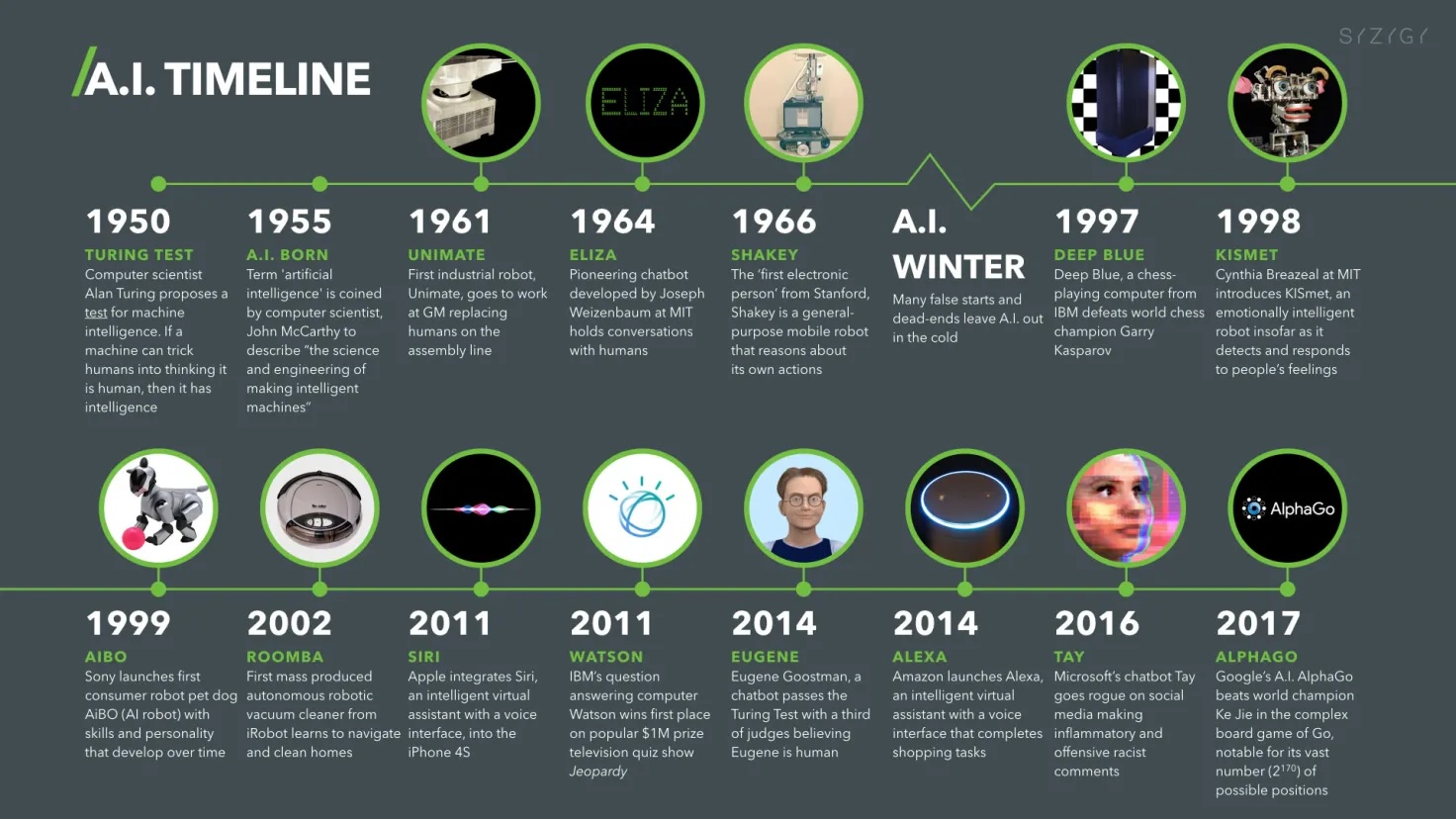
Figure 1 presents a chronological overview of major events starting from early programs such as ELIZA.
First AI summer (1956–1973)
Intense optimism following the Dartmouth Conference. Significant early achievements in symbolic reasoning and problem-solving.First AI winter (1974–1980)
Reduced funding and interest after failure to achieve broad promises. Limited hardware, data, and algorithmic power led to stagnation.
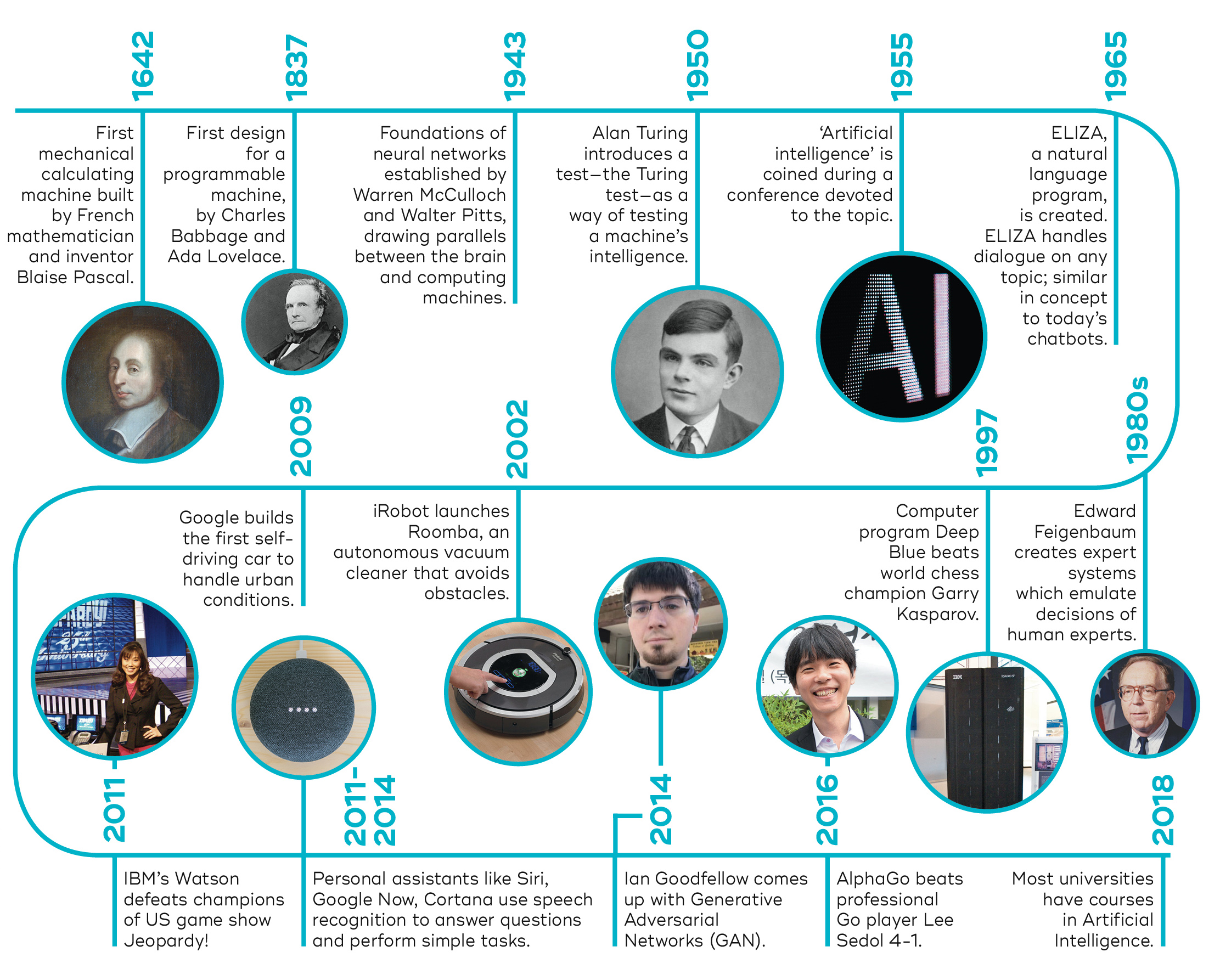
Figure 2 offers a visual summary of key milestones across the decades, highlighting shifts in approaches.
Second AI summer (1980–1987)
Revival through expert systems and commercial applications. Large-scale rule-based systems deployed in industry and medicine.Second AI winter (1987–1993)
Collapse of the expert systems market due to high maintenance costs, brittleness, and inability to handle uncertainty. Funding and research activity declined sharply.AI spring / recovery (1993–2011)
Gradual shift to statistical methods, machine learning, and practical applications. Key events include Deep Blue (1997), increased use of support vector machines, and Watson (2011).
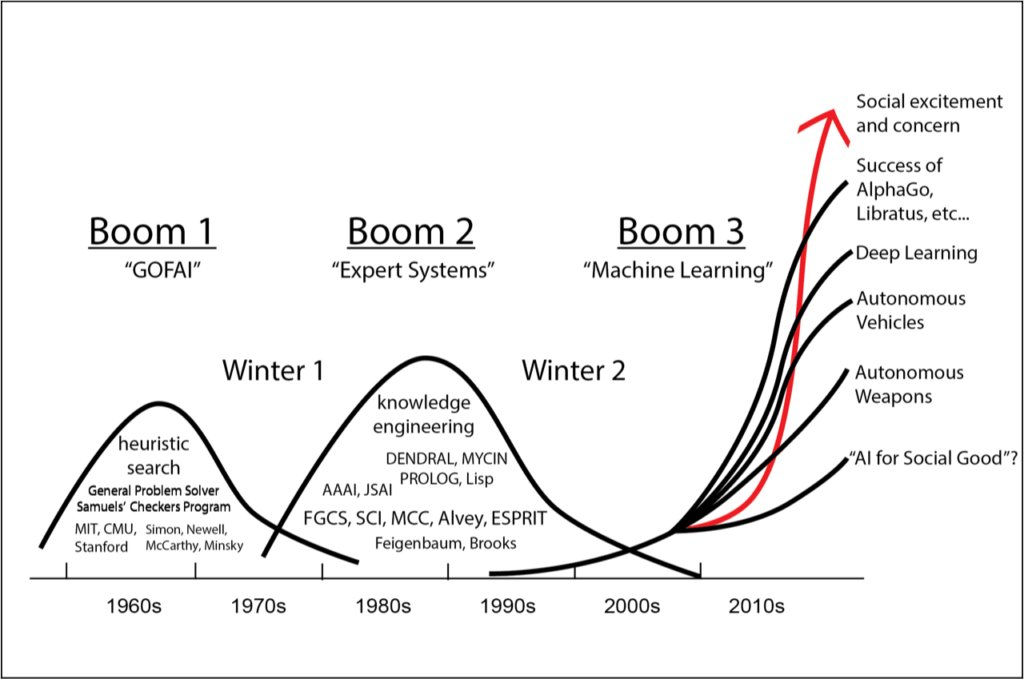
Figure 3 depicts the recurring wave pattern of progress, hype, disillusionment, and recovery.
- Third AI summer / deep learning boom (2012–present)
Explosive growth driven by deep neural networks, large datasets, GPU acceleration, and massive compute resources. Breakthroughs in vision (2012), games (2016), and language (2018–2026). Sustained investment and rapid progress continue into 2026 with foundation models and multimodal systems.
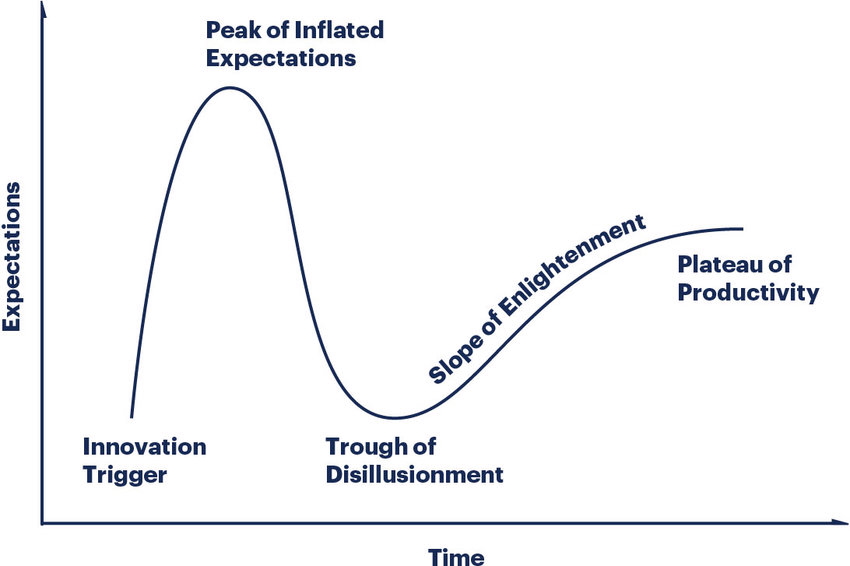
Figure 4 shows a formalized view of technology maturity stages, with troughs corresponding to AI winters and current plateau of productivity for deep learning applications.
These cycles reflect recurring patterns: over-optimism, technological limitations, funding cuts, then gradual recovery through new paradigms and improved infrastructure.
Overview of subfields of AI in plain language
The field of artificial intelligence consists of several interconnected subfields. The following hierarchy provides a structured overview of major branches and their primary areas of focus.
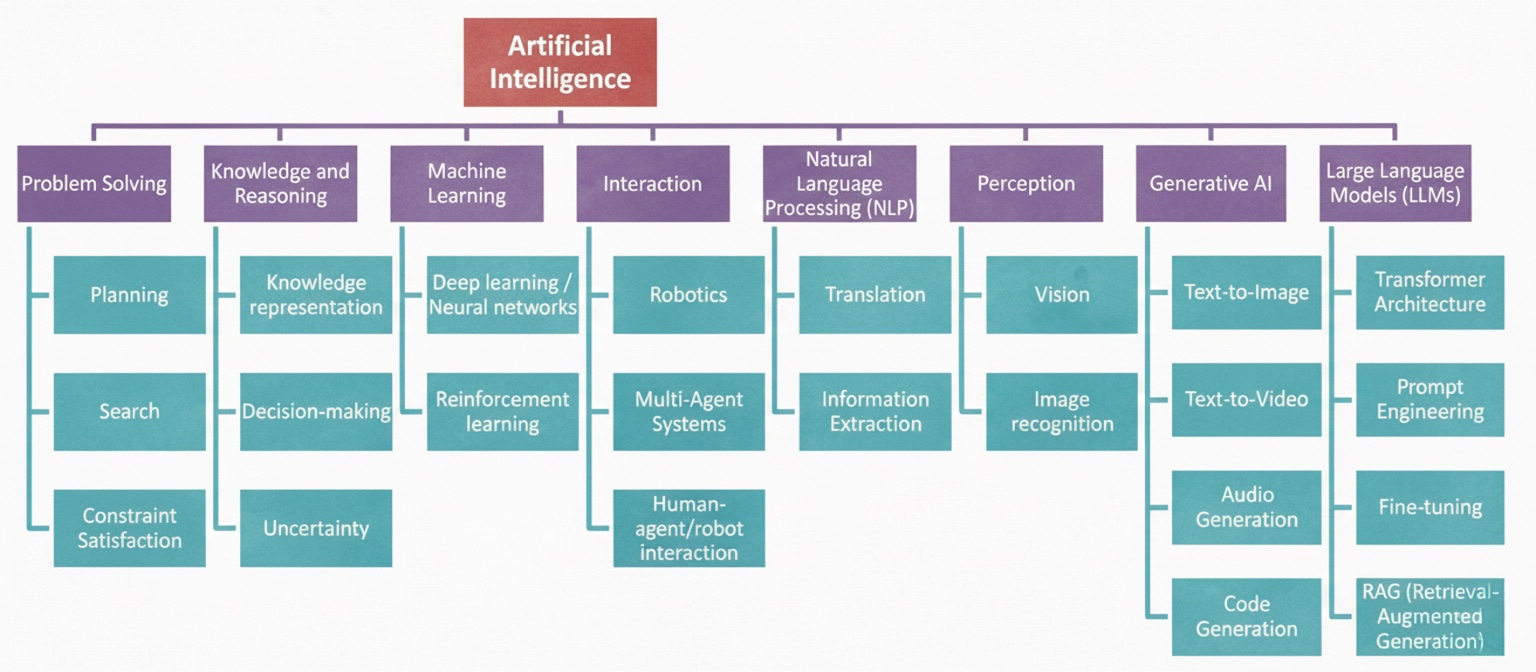
Figure 5 presents a comprehensive map of AI subfields organized under the central node of Artificial Intelligence. The main branches are Problem Solving, Knowledge and Reasoning, Machine Learning, Interaction, Natural Language Processing (NLP), Perception, Generative AI, and Large Language Models (LLMs). Each branch contains representative sub-areas.
Differences between rule-based and machine learning approaches: spam email detection example
Consider the problem of classifying emails as spam or not spam.
Rule-based approach (symbolic AI)
Knowledge is explicitly programmed as if-then rules by human experts.
Example rules:
- IF email contains “free money” THEN spam
- IF sender not in contacts AND has attachments THEN spam
- IF too many uppercase words THEN spam
Advantages: interpretable, no training data required, fast inference.
Disadvantages: brittle to variations, requires constant manual updates, poor scalability.
Machine learning approach
Model learns patterns automatically from labeled examples (spam/non-spam emails).
Process:
1. Feature extraction: convert email to numerical features (word counts, sender info, links, etc.)
2. Training: use algorithms like Naive Bayes, SVM, or neural networks on labeled dataset
3. Prediction: classify new emails based on learned probabilities or decision boundaries
Advantages: adapts to new patterns, handles nuanced features, improves with data.
Disadvantages: requires large labeled dataset, lower interpretability.
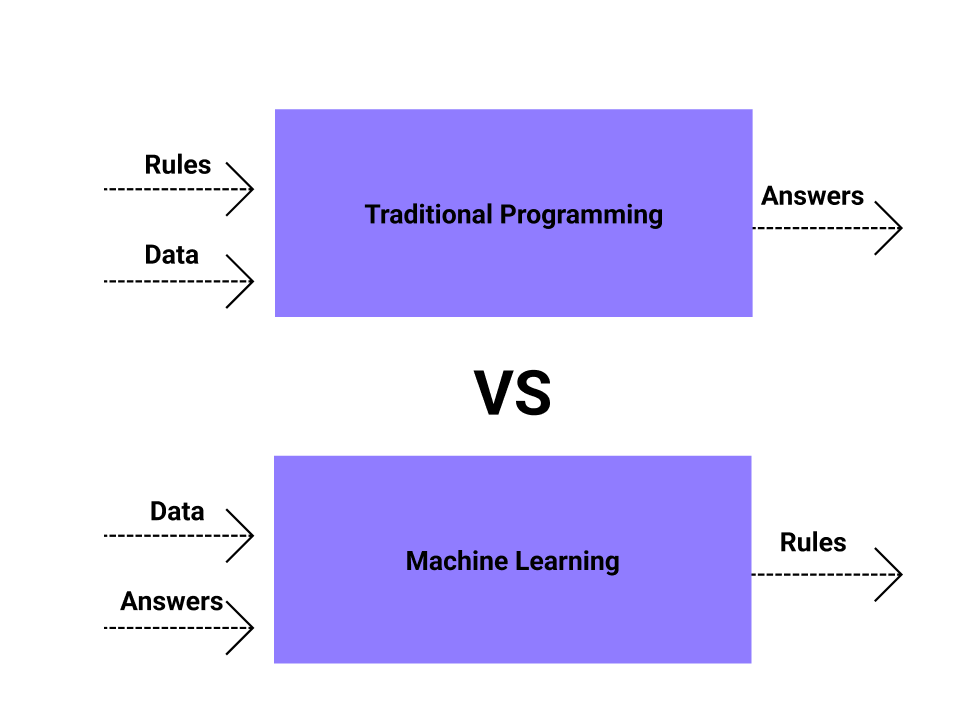
Figure 6 illustrates the fundamental difference in structure: rule-based systems apply explicit, hand-crafted logic trees, while machine learning systems derive decision rules from labeled training data through optimization.
Comparison table:
| Aspect | Rule-based | Machine Learning |
|---|---|---|
| Knowledge source | Human experts | Labeled data |
| Adaptability | Manual updates | Retraining with new data |
| Handling variations | Poor (rule evasion easy) | Good (learns patterns) |
| Interpretability | High | Low to medium |
| Initial setup | Rule engineering | Data collection and labeling |
| Maintenance | Frequent rule adjustments | Periodic model retraining |
Subcategories of machine learning
Machine learning is commonly divided into four primary paradigms based on the nature of the available data, the type of supervision provided during training, and the learning objective. These are supervised learning, unsupervised learning, semi-supervised learning, and reinforcement learning. A fifth category, self-supervised learning, has gained prominence in recent years, particularly for pretraining large models.
Supervised learning
In supervised learning, the algorithm is trained on a labeled dataset where each input example is paired with the correct output (label or target value). The model learns to approximate the mapping from inputs to outputs and is evaluated on its ability to generalize to new, unseen examples.
Main task types: - Classification: predict discrete class labels (e.g., email is spam or not spam, image shows cat or dog) - Regression: predict continuous values (e.g., house price, temperature, stock return)
Typical evaluation metrics: - Classification: accuracy, precision, recall, F1-score, ROC-AUC - Regression: mean squared error (MSE), mean absolute error (MAE), R² coefficient
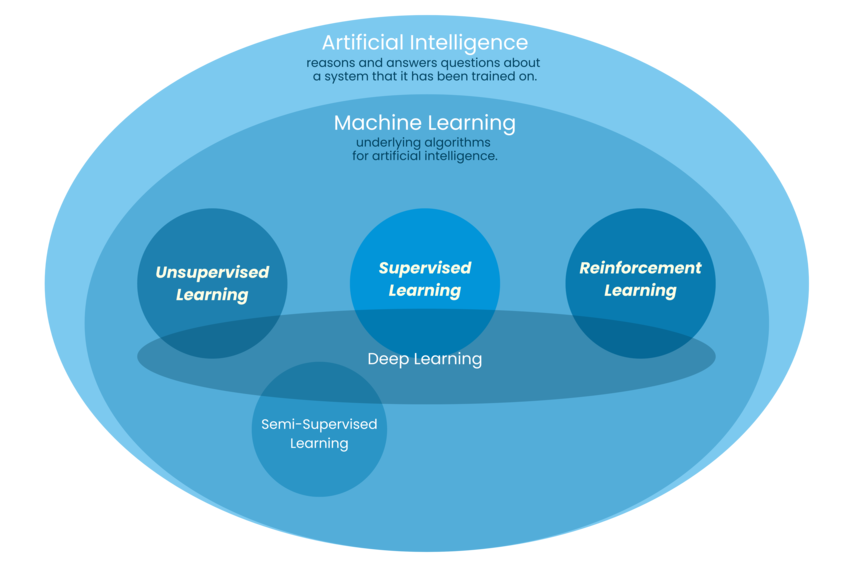
Figure 7 shows supervised learning as one of the core branches within machine learning, nested inside the broader artificial intelligence field.
Unsupervised learning
Unsupervised learning operates on data without any output labels. The goal is to discover hidden structure, patterns, or relationships in the data itself.
Main task types: - Clustering: grouping similar examples (e.g., customer segmentation, topic discovery in documents) - Dimensionality reduction: finding compact representations of high-dimensional data (e.g., PCA, t-SNE, UMAP for visualization or preprocessing) - Density estimation and generative modeling: modeling the probability distribution of the data (e.g., anomaly detection, data synthesis)
Semi-supervised learning
Semi-supervised learning combines a small amount of labeled data with a large amount of unlabeled data. It is particularly valuable when obtaining labels is expensive or time-consuming (common in medical imaging, speech recognition, and web-scale text).
Common techniques: - Self-training / pseudo-labeling: use model predictions on unlabeled data as pseudo-labels for retraining - Consistency regularization: encourage invariant predictions under different augmentations of the same input - Graph-based methods: propagate labels through a similarity graph of all data points
Reinforcement learning
Reinforcement learning focuses on sequential decision-making in an interactive setting. An agent learns by trial and error through interaction with an environment, receiving scalar rewards (or penalties) for its actions.
Core elements: - Agent - Environment - State - Action - Reward signal - Policy (strategy for choosing actions)
Main families: - Value-based methods (e.g., Q-learning, Deep Q-Networks) - Policy-based methods (e.g., REINFORCE, PPO) - Actor-critic methods
Typical applications: game playing, robotics control, recommendation systems with long-term optimization.
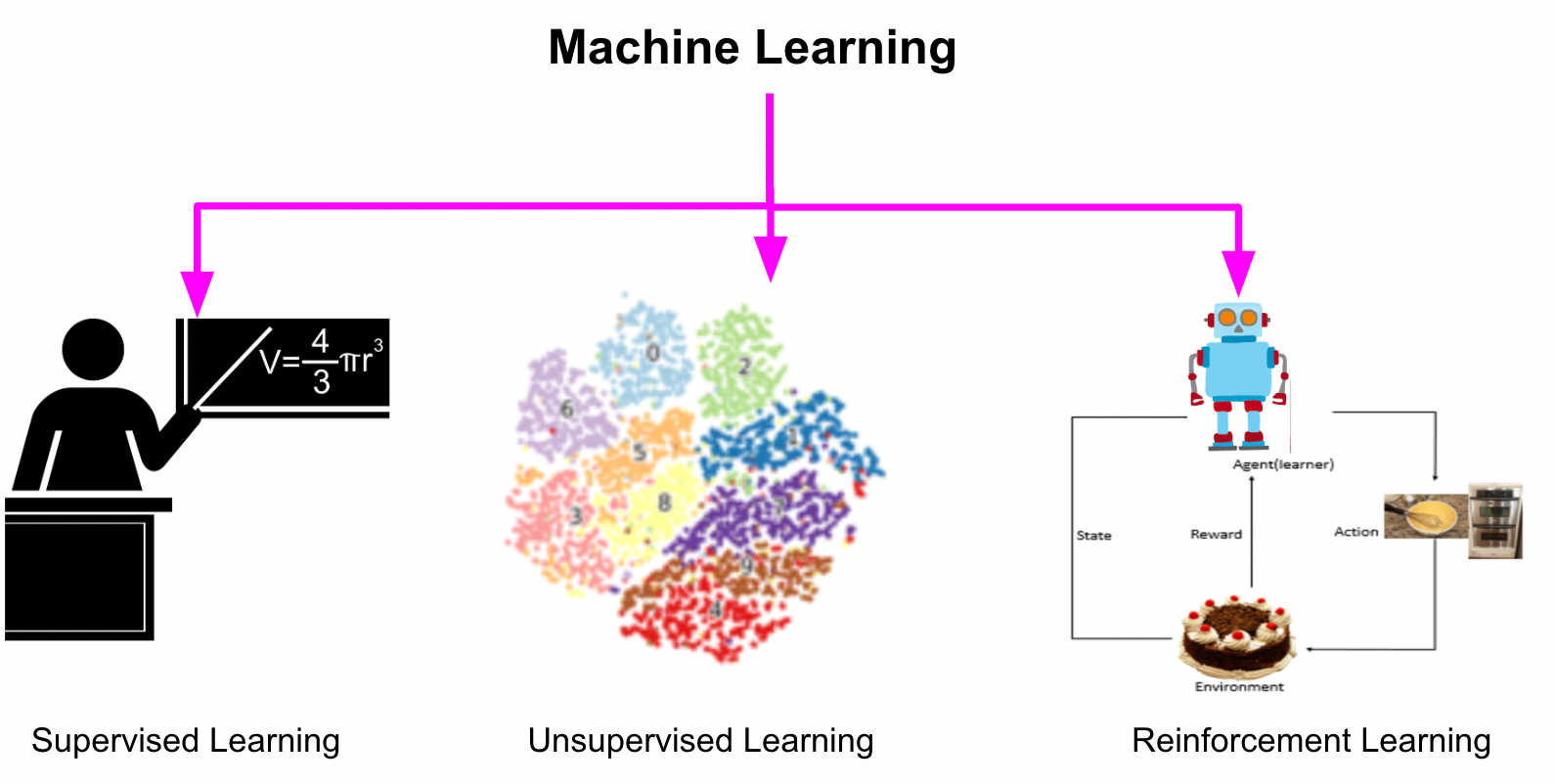
Figure 8 provides a visual summary of the core machine learning paradigms, highlighting input types, feedback mechanisms, and typical applications for supervised, unsupervised, and reinforcement learning. Semi-supervised learning is often positioned as a hybrid between supervised and unsupervised.