Foundations of AI
Core Concepts
Theoretical Inception and the Turing Test
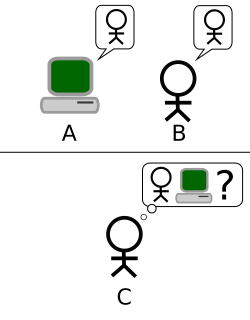
The assumption that human thought can be mechanized predates modern computing, rooted in formal logic and the creation of automata. In 1950, Alan Turing proposed the “Imitation Game,” or Turing Test, measuring machine intelligence based on whether a human can distinguish between a machine and a human during conversation.
| Feature | Description |
|---|---|
| Objective | To bypass the difficulty of defining “thinking” in favor of empirical behavior. |
| Mechanism | A blind, text-based conversation between an interrogator, a human, and a machine. |
| Criterion | Intelligence is judged by the interrogator’s inability to distinguish the machine from the human. |
The Dartmouth Conference and Symbolic AI
AI was formally established at the Dartmouth Summer Research Project in 1956. Early research was dominated by Symbolic AI, which hypothesized that human thought is the manipulation of high-level symbols. Notable successes included Logic Theorist and ELIZA.
| Period | Milestone | Key Technology/Concept |
|---|---|---|
| 1950 | Turing Test | Practical measurement of machine intelligence. |
| 1956 | Dartmouth Workshop | Birth of AI as a formal discipline; term coined by John McCarthy. |
| 1960s | Early Successes | General Problem Solver, ELIZA (first chatbot), and Logic Theorist. |
Expert Systems and AI Winters
In the 1980s, corporations adopted expert systems to solve domain-specific problems using rules from human specialists. These systems were brittle, failing outside their rule sets, leading to “AI winters” of funding cuts and public skepticism.
| Cycle | Cause of Downturn | Key Limitation |
|---|---|---|
| First Winter (1974–1980) | Lighthill Report and DARPA funding cuts. | Limited memory and combinatorial explosion. |
| Second Winter (1987–1993) | Collapse of specialized AI hardware markets. | High maintenance costs of brittle expert systems. |
Connectionism and Deep Learning
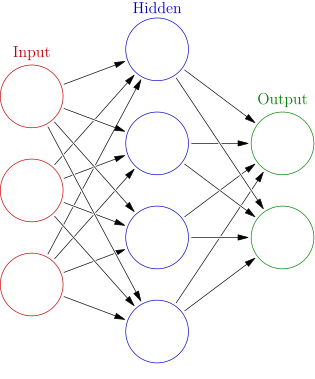
Connectionism models intelligence using neural networks inspired by the brain. Deep learning became dominant after 2012 due to Big Data and GPUs.
| Paradigm | Approach | Learning Logic |
|---|---|---|
| Symbolic AI | Top-Down | Explicitly programmed with rules and logic. |
| Connectionism | Bottom-Up | Data-driven; learns patterns from examples. |
Transformer Architecture and Generative AI
Transformers (2017) introduced self-attention mechanisms, enabling Large Language Models (LLMs) and generative AI with human-like reasoning and creativity.
Case Study: IBM Watson on Jeopardy! (2011)
Watson defeated human champions on Jeopardy! by interpreting puns, idioms, and phrases, demonstrating advanced NLP and real-time confidence scoring.
Activity: Analyzing the Algorithmic Cultivation Cycle
- Identify four components: Human needs, Smartphone data surveillance, Personalized content algorithms, Agential expression.
- Analyze how “Personalized Content Algorithms” create echo chambers and identity profiling.
- Evaluate real-world examples leading to behavioral or ideological regulation.